
By: Hunter Mylek
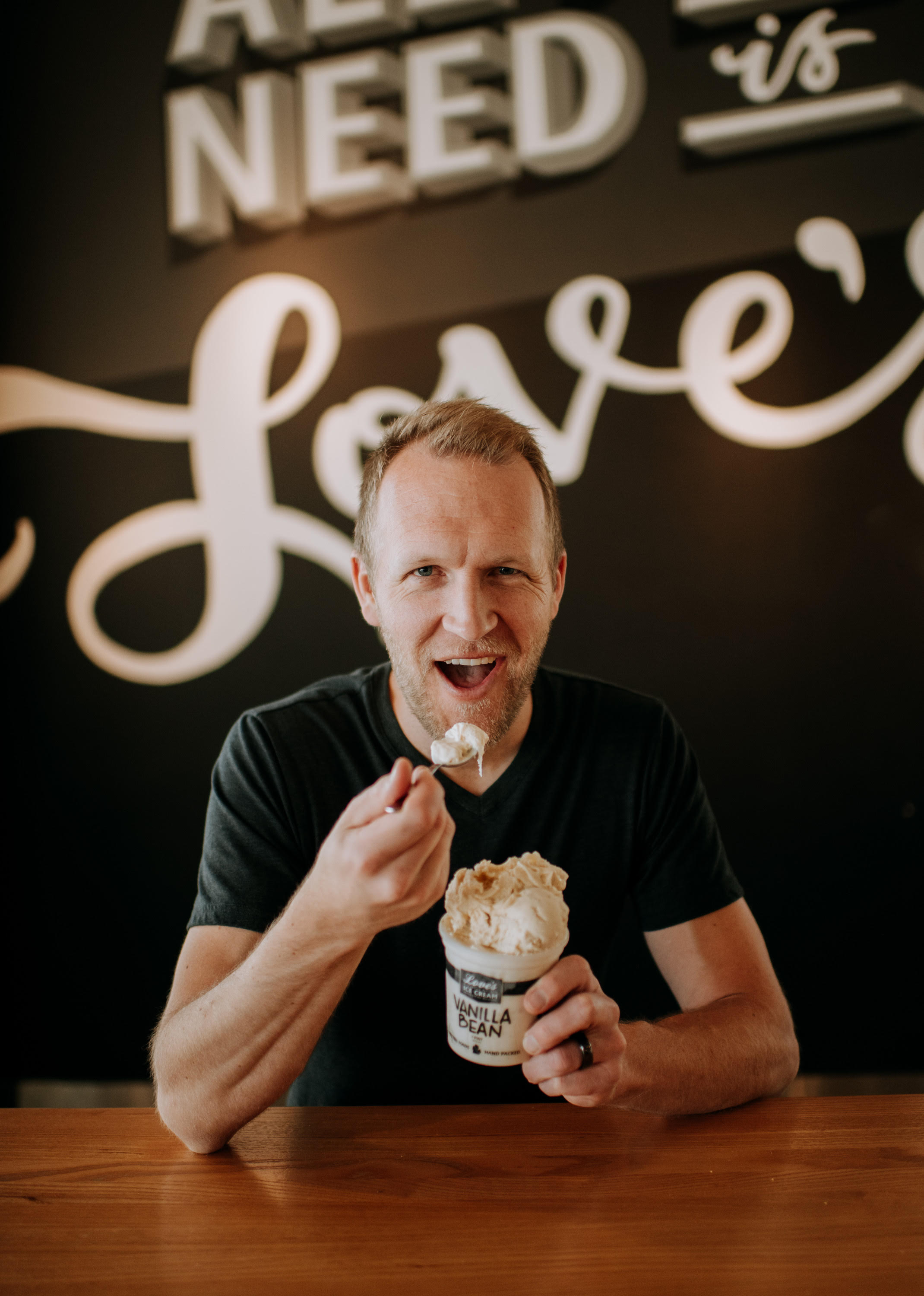
Q: Can you share a little bit about yourself?
A: “Born and raised in West Michigan, attended GRCC and GVSU for business. Worked in marketing for a local musical instrument retailer, then started an e-commerce web development business in 2007 to enable me to tour the country playing shows in an independent rock band and still afford a mortgage. Slowly turning my attention toward food, I sold that business to a competitor in 2011 and went to culinary school. In 2013 I opened Love’s Ice Cream and we will celebrate 10 years at the end of August. I love to be active, and to adventure, with hiking being my chief passion. I’m involved in two food startups that I am excited to see where they go”.
Q: What is Love’s Ice Cream?
A: “Worthy treats for every. body. Meticulously made from scratch from intentionally sourced ingredients”.
Q: What made you want to start this business?
A: “I was early into my journey of learning about food — where ingredients come from, their practical applications, what makes a top-caliber ingredient better than another, and how to prepare them to make delicious food. During that time, making ice cream at home became a hobby. I knew what was going into it, how it was made, and it was a blank canvas for all manner of flavor expeditions. I saw an opportunity in the West Michigan market at the time — nobody else was taking this approach to making ice cream. Minimally processed, high intention to sourcing”.

Q: Why do you feel it is important to source your ingredients organically and locally?
A: “Ice cream is a globally constructed product in our case, with vanilla from Madagascar and Indonesia, sugar cane from Brazil, cocoa from Dominican Republic and Tanzania, etc. However, if it grows in Michigan and we can source ingredients that meet our profile specifications, we absolutely buy it — this is predominantly fruit, mint, and lavender. There are regulatory hurdles that create difficulties for small businesses to access the caliber of ingredients desired, especially when it comes to milk. As much as we are able to purchase locally or from Michigan, we do. Keeping money in the hands of local companies strengthens our communities economically. Spending our ingredient dollars with distributors that align with our values, especially ones that source from organic or regenerative farms, B-Corps, earth and people conscious — if our money is supporting them, then our mission is amplified by the ripple effect from those expenditures. These are the business relationships I seek and sustain”.
Q: What is the ice cream flavor that you couldn’t live without?
A: “Cookies & Cream from Love’s. A nostalgic flavor to be sure, but now that we make a version that in my humble opinion is superior to any other Cookies & Cream I’ve had, it’s a flavor I find exquisite and that I’m proud of. The cookies of course are made in house, organic and non-GMO, made gluten free with sorghum and oat flour, filled with real buttercream instead of a hydrogenated oil substitute, slavery-free cocoa, etc. Fold these cookies into a non-homogenized grass-fed cow’s cream pure vanilla base and a bit of magic is created. I often wonder if it is actually magic or simply being a thoughtful and responsible chef and business”.
Q: Do you believe your culinary background benefited you in your journey to becoming an entrepreneur?
A: “My culinary background has helped me succeed in the food sphere. I believe that all business requires certain skills and understanding, but there is/are specific industry knowledge, experience, and skills that can help you deliver successful products and services to a market. So in effect, they go hand in hand. A business cannot succeed without a product. A product cannot succeed without the structure of a business to manage its distribution and life cycle”.

Q: Have you always seen yourself becoming an entrepreneur, and have you always pictured it would be within this industry?
A: “Hilariously in high school I vowed to my friends I would never work in the food industry. I had no experience with restaurants or food service prior to culinary school. I took the leap to start a company when I was 25 out of a desire to cover my expenses while trying to make my dreams of being a full-time musician a reality, so entrepreneurship was born out of necessity. It was never an explicit goal. I suppose the grind of being in a touring band taught me some about small business ownership. Another fraction of it I learned working for a small music store for 8 years. The most valuable lessons have been learned by actually doing, and often, finding out the hard way first”.
Q: What hurdles did you face along the way and how did you overcome them?
A: “The hurdles have been innumerable, and this could be the content for a book. If I think about it from a higher level, I would place them into three buckets: unforeseen issues (I didn’t know what I didn’t know), expected issues, and issues due to a lack of experience. Some of these overlap of course. Here are some examples:
Unforeseen issues: (1) The government can handicap our ability to conduct commerce with various decrees. I had not even the slightest clue this was possible, and when it happened, it was devastating. (2) Equipment failure, to the extent it actually happens. (3) Difficulty with a landlord finding sensible common ground.
Expected issues: (1) Managing people and the messiness of dealing with different personalities, preferences, and motivations. (2) Equipment failure, which I expected once in a while, but it’s nearly weekly and it’s interminable despite best efforts to purchase high-quality equipment and keep it well maintained.
Lack of experience: (1) Opening a pizza restaurant in 2016 and closing it in 2018 because it was the wrong model for the location. (2) Trying to save expenses by doing things myself or internally, like washing kitchen linens. Some things are worth paying for in trade for more focus, less stress”.
Q: What advice do you have for aspiring entrepreneurs?
A: “I’ve contemplated writing a book on this very topic! Understanding the fundamentals of business is so critical. Despite having a great product, a company will fail if the business is not sound. Learning this doesn’t have to be difficult or complex. My strong advice is to work for a company and be a sponge. Be observant, ask questions, but in the process, be a real value to that organization in return. Taking this approach, you will get paid to learn how a business operates — from accounts payable to HR to marketing. Proficiency in these areas is not required, but an understanding of each department’s function and importance will allow an entrepreneur to properly support their product or offering. To support what you are learning out in the real world, read the E-Myth by Michael Gerber. As a solopreneur, you are filling every role in every department yourself. Over time, you relinquish the roles to others as revenue and strategy necessitate”.

To learn more about Love’s Ice Cream, visit the website today or visit them in person at The Downtown Market.
 NEU
NEU 